In Germany, an e-scooter needs insurance before it touches a public road. Not as an option, not after a few months: from the first metre. The proof is the small insurance plate (Versicherungskennzeichen) stuck on the back of the scooter, and it changes colour every year on 1 March. This guide explains who needs it, what it costs, how to get it, what it covers and what does not, and what changes for e-scooter riders in 2027.
In short: liability insurance is compulsory for every e-scooter used on public roads in Germany. It costs roughly €20 to €60 a year for third-party liability, more for riders under 23 or with theft cover. The plate for the year from 1 March 2026 to 28 February 2027 is black; from 1 March 2027 it will be blue. Only scooters with a German ABE approval can be insured for road use.
Is E-Scooter Insurance Mandatory in Germany?
Yes. Since the e-scooter ordinance (eKFV) came into force on 15 June 2019, e-scooters count as small electric vehicles (Elektrokleinstfahrzeuge) and fall under the compulsory insurance law, like mopeds. Every scooter ridden on public roads, cycle paths or anywhere open to traffic must have:
- a general operating permit (ABE) or an individual approval,
- a valid third-party liability insurance,
- the matching insurance plate in the colour of the current year, fixed at the rear.
Riding without valid insurance is not a simple traffic offence: it is a criminal offence under the Compulsory Insurance Act (Pflichtversicherungsgesetz), punishable by a fine or up to one year in prison. If you cause an accident without insurance, you also pay the damage yourself, which can run into tens of thousands of euros after an injury.
The same applies with an expired plate: a green plate from 2025/26 has given no cover since 1 March 2026.
Which Scooters Can Be Insured? The ABE Question
This is where many buyers get caught. A German insurer will only issue a plate for a scooter that has a valid ABE (or individual approval). The eKFV sets the technical limits for that approval:
| Requirement | Rule in Germany |
|---|---|
| Maximum design speed | 20 km/h |
| Motor rated power | 500 W maximum (1,400 W for self-balancing vehicles) |
| Brakes | Two independent brakes |
| Lights | Front and rear lights, reflectors |
| Other | Bell, handlebar or holding bar, maximum weight 55 kg without rider |
| Rider | Minimum age 14, no driving licence, no helmet obligation |
Most scooters sold elsewhere in Europe are limited to 25 km/h: they are road-legal in France or Spain, but not in Germany, and you cannot insure them for German roads. A scooter that is only "limited by software" without an ABE certificate does not qualify either.
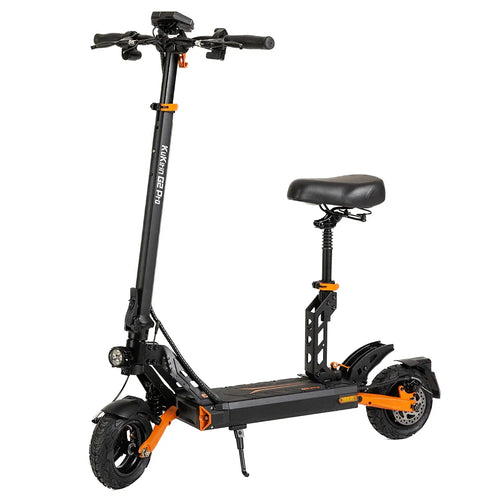
- Top speed45 km/h
- Range65 km
- Motor power600W
- Battery48V 15.6Ah
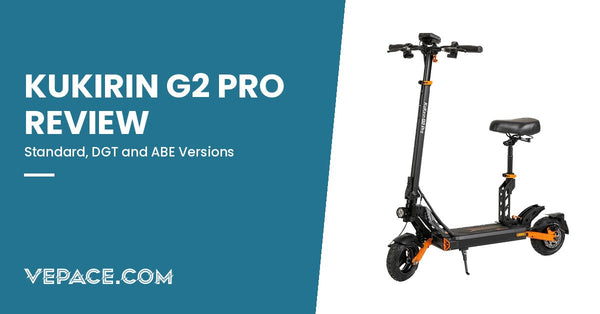
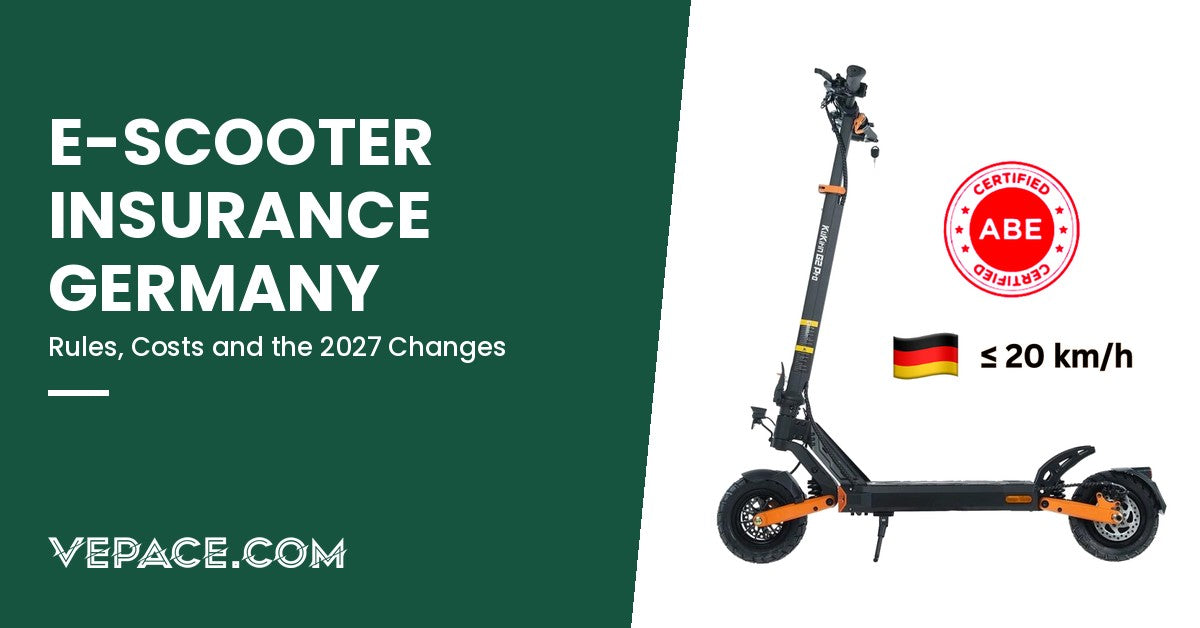
The Kukirin G2 Pro exists in an ABE version built for Germany: 500 W motor, limited to 20 km/h, up to 65 km of claimed range, and a space on the rear mudguard for the insurance plate. Choose the "ABE" version on the product page. You can find every approved model in our ABE certified electric scooters collection.
How Much Does E-Scooter Insurance Cost?
The plate itself is free: you pay the insurance premium, and the plate comes with the contract. Prices depend on the insurer, your age and the cover you choose. Typical yearly prices in 2026:
| Cover | What it pays for | Typical price per year |
|---|---|---|
| Third-party liability (compulsory) | Damage and injuries you cause to others | About €20 to €60 |
| Liability, rider under 23 | Same cover, higher risk group | Noticeably more, often €50 or more |
| Liability + partial cover (Teilkasko) | Adds theft, fire, storm, sometimes battery damage | About €40 to €120 |
Two details lower the price:
- Start date: the insurance year always runs from 1 March to the end of February. If you start later in the year, most insurers charge only the remaining months. Buying a scooter in November means paying for about four months, then renewing on 1 March.
- Age and number of riders: some insurers charge less if only riders over 23 use the scooter.
Prices change every season; compare several insurers before you sign.
Plate Colours: Which One Is Valid?
The plate colour changes every year on 1 March in a fixed three-year cycle, so the police can see at a glance whether the cover is current.
| Insurance year | Plate colour | Valid |
|---|---|---|
| 1 March 2025 to 28 February 2026 | Green | No longer valid |
| 1 March 2026 to 28 February 2027 | Black | Valid now |
| 1 March 2027 to 29 February 2028 | Blue | From 1 March 2027 |
The plate does not renew itself. If your contract continues, the insurer usually sends the new plate before 1 March; if you change insurer, order the new plate in time so you are not left without cover on 1 March.
How to Get Your Insurance Plate, Step by Step
- Check the ABE: you need the scooter's ABE number and its vehicle identification number (on the frame or the type plate). Both are in the documents delivered with an approved scooter.
- Choose an insurer: most car insurers and many online brokers sell e-scooter plates. Compare price, theft cover and the age rules.
- Apply online or in a branch: give the ABE number, the vehicle number, the rider's date of birth and the start date.
- Receive the plate: it arrives by post, usually within a few days. It is a sticker with the insurer's code and the year colour.
- Stick it on the rear of the scooter, clearly visible, on the plate holder or the rear mudguard.
- Keep the insurance certificate with you or on your phone.
What the Insurance Covers, and What It Doesn't
Liability (compulsory) pays for damage you cause to other people: injuries to a pedestrian, a scratched car, a broken shop window. It does not pay for your own scooter or your own injuries.
Partial cover (Teilkasko) adds protection for your own scooter against theft, fire and storm damage, and some contracts include the battery. It is worth it for expensive scooters and for anyone who parks outside.
Insurers can refuse to pay, or claim money back from you, if the scooter was modified (speed limiter removed, more power), if the rider was under the influence of alcohol, or if the scooter was used for something it is not approved for. An unlocked scooter loses its ABE and with it the insurance cover.
What Changes in 2027
Germany adopted a reform of the e-scooter ordinance: the Federal Council approved it on 19 December 2025, and it was published on 6 February 2026. It comes in stages:
- From 1 January 2027: turn signals for new scooters. Newly approved e-scooters must have indicators. Scooters already approved and on the road do not need to be retrofitted, according to the Federal Ministry of Transport.
- From 1 March 2027: cycling rules. Most behaviour rules for e-scooter riders move into the general road traffic regulations and are aligned with the rules for cyclists, including the fines.
- Rental scooters: cities get more power to regulate where shared scooters are parked.
The insurance obligation itself does not change: the blue plate will be required from 1 March 2027.
Riding Abroad With a German Plate
A German insurance plate covers liability in Germany. Other countries have their own e-scooter rules (speed, age, helmets, plates), and some require their own registration. Check the rules of each country before taking your scooter on holiday; our overview of electric scooter laws in Europe is a good starting point.
Checklist Before You Ride
- Scooter with ABE (or individual approval), 20 km/h maximum.
- Valid insurance contract and the plate in this year's colour (black until 28 February 2027).
- Plate fixed at the rear and readable.
- Lights working, both brakes working, bell fitted.
- Rider at least 14 years old; no alcohol.
- Speed limiter untouched.
Looking for a scooter that ticks every box? Start with the Kukirin G2 Pro ABE, and read our full comparison of the G2 and G2 Pro.
Official sources: Elektrokleinstfahrzeuge-Verordnung (eKFV) · Federal Government: new rules for e-scooters. Insurance prices are typical market prices in 2026 and vary by insurer. This guide is general information, not legal advice.